


Most drivers think about crash risk in terms of how they drive. Fewer think about when they drive. Yet in Arizona, the clock and the calendar say a lot about danger on the road.
To find out when Arizona’s most serious crashes happen, we looked at 10 years of federal crash data. Below, we break it down by hour, by day of the week and by month, and we compare Arizona with the rest of the country along the way. When you know when the risk is highest, you can plan ahead, stay alert and protect the people you love.
Key Insights
- 6 to 9 p.m. was Arizona’s deadliest time of day in all 10 years.
- Friday from 6 to 9 p.m. was the single deadliest time slot of the week.
- Saturday was the deadliest day overall, with Friday close behind.
- October was the deadliest month, but spring and fall both run high.
- Nearly half of Arizona’s fatal crashes happened in the dark. Rain played a very small role.
Our Study Methodology
We used the National Highway Traffic Safety Administration’s (NHTSA) Fatality Analysis Reporting System (FARS), which tracks every fatal crash on U.S. public roads. We looked at Arizona from 2015 through 2024. Over those 10 years, the state recorded 9,968 fatal crashes. These figures count crashes, not deaths, since one crash can take more than one life.
The trend over the decade matters, too. Arizona’s yearly total rose from 811 fatal crashes in 2015 to a peak of 1,200 in 2022, and stood at 1,118 in 2024. That’s about 38% higher than in 2015. Nationwide, fatal crashes rose by about 12% over the same years.
When Most Of Fatal Crashes Happen in Arizona?
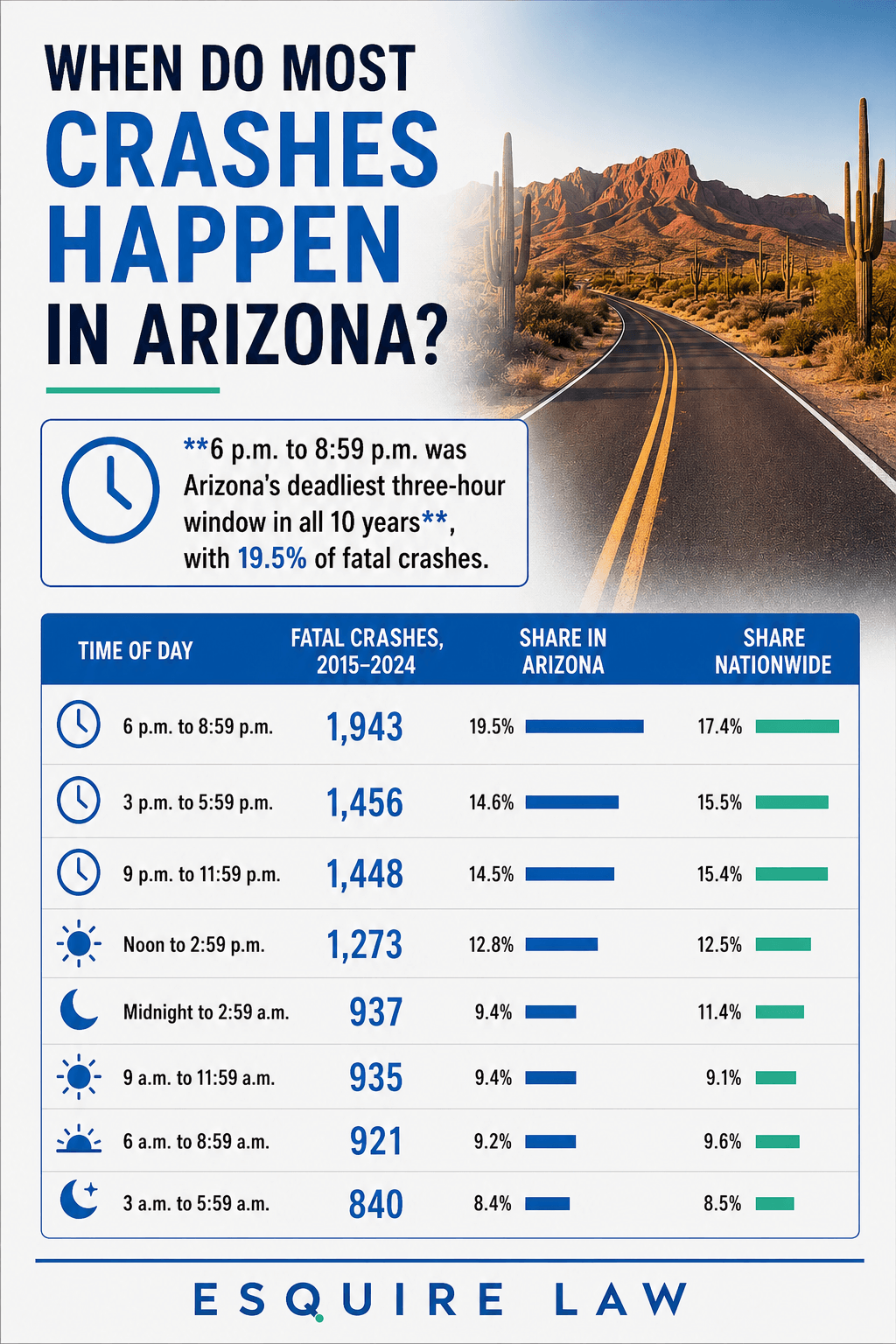
One time block led every single year. 6 p.m. to 8:59 p.m. was Arizona’s deadliest three-hour window in all 10 years, with 19.5% of fatal crashes.
Arizona Fatal Crashes by Time of Day, 2015–2024
| Time of Day | Fatal Crashes, 2015–2024 |
Share in Arizona |
Share Nationwide |
|---|---|---|---|
| 6 p.m. to 8:59 p.m. | 1,943 | 19.5% | 17.4% |
| 3 p.m. to 5:59 p.m. | 1,456 | 14.6% | 15.5% |
| 9 p.m. to 11:59 p.m. | 1,448 | 14.5% | 15.4% |
| Noon to 2:59 p.m. | 1,273 | 12.8% | 12.5% |
| Midnight to 2:59 a.m. | 937 | 9.4% | 11.4% |
| 9 a.m. to 11:59 a.m. | 935 | 9.4% | 9.1% |
| 6 a.m. to 8:59 a.m. | 921 | 9.2% | 9.6% |
| 3 a.m. to 5:59 a.m. | 840 | 8.4% | 8.5% |
The early evening stands out even more in Arizona than across the U.S. It’s the time when the workday ends, the sun goes down and many people head out for the evening.
Arizona’s deadliest crashes are also shifting later. The share of fatal crashes between 6 p.m. and 6 a.m. rose from 50.4% in 2015–2019 to 53.0% in 2020–2024. The 9 p.m. to midnight block grew from 13.2% to 15.6%. The national data shows the same shift.
Why are evenings so dangerous? There’s no single answer, and every crash has its own causes. Darkness, fatigue and impaired driving may all play a part. Nationally, NHTSA reports that in 2022, 32% of drivers in fatal nighttime crashes were alcohol-impaired, compared with 11% during the day.
The Deadliest Days on Arizona: Saturday, With Friday Close Behind
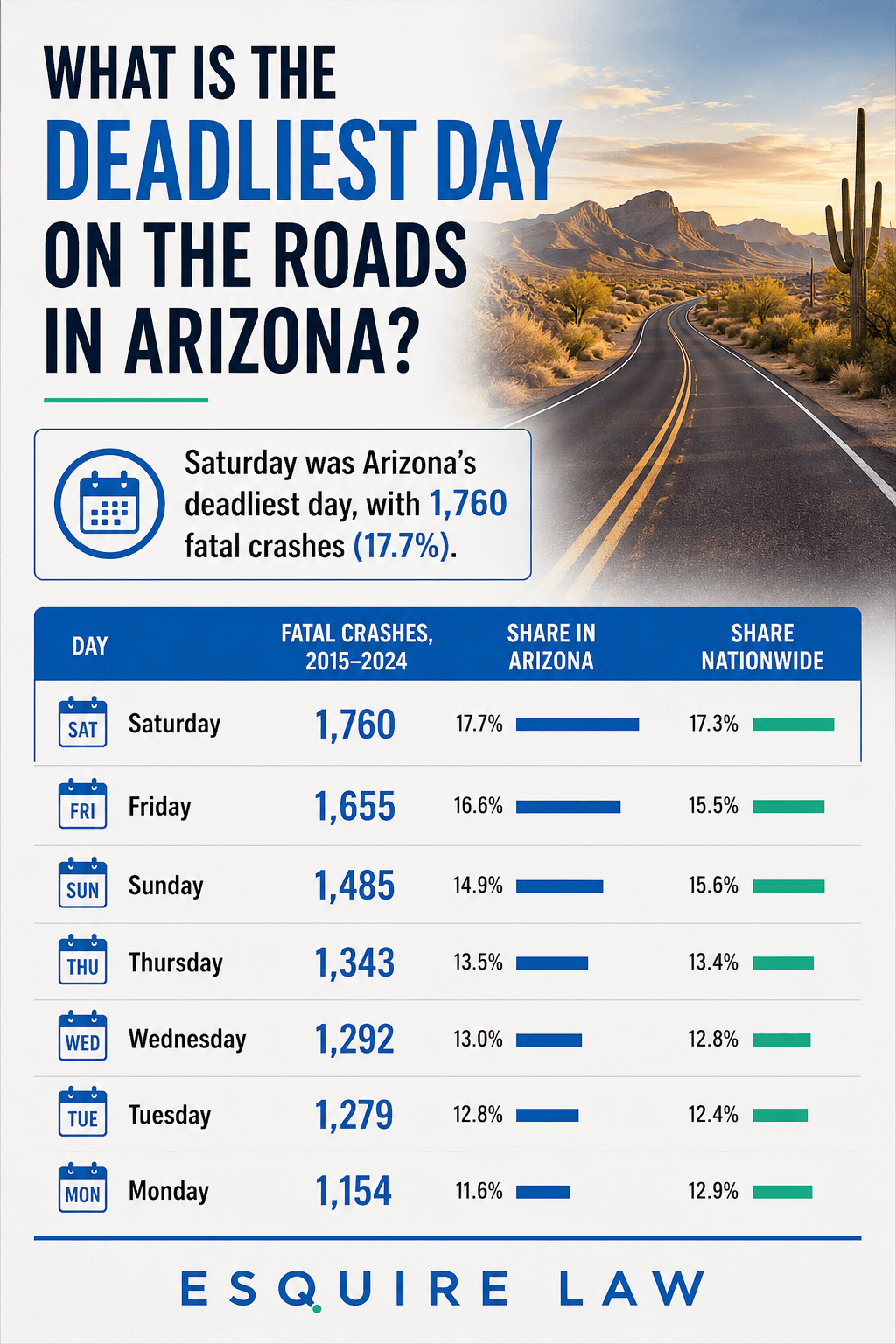
Saturday was Arizona’s deadliest day, with 1,760 fatal crashes (17.7%). Here, Arizona breaks from the national pattern. Across the U.S., Sunday ranks second. In Arizona, Friday is a close second, well ahead of Sunday.
Arizona Fatal Crashes by Day of the Week, 2015–2024
| Day | Fatal Crashes, 2015–2024 |
Share in Arizona |
Share Nationwide |
|---|---|---|---|
| Saturday | 1,760 | 17.7% | 17.3% |
| Friday | 1,655 | 16.6% | 15.5% |
| Sunday | 1,485 | 14.9% | 15.6% |
| Thursday | 1,343 | 13.5% | 13.4% |
| Wednesday | 1,292 | 13.0% | 12.8% |
| Tuesday | 1,279 | 12.8% | 12.4% |
| Monday | 1,154 | 11.6% | 12.9% |
Saturday led in 7 of the 10 years, and Friday led in the other three (2017, 2021 and 2024). Together, Friday, Saturday and Sunday accounted for 49% of Arizona’s fatal crashes. Monday was the least deadly day, and Saturday saw about 53% more fatal crashes than Monday.
When we combine the day and the hour, one slot stands out. Friday from 6 to 9 p.m. was Arizona’s single deadliest time of the week, with 371 fatal crashes over 10 years. Saturday from 6 to 9 p.m. came next. Nationally, the peak comes later, on Saturday from 9 p.m. to midnight. In Arizona, the danger tends to start as soon as the workweek ends. Fatal crashes in that Friday evening slot also more than doubled over the decade, from 23 in 2015 to 49 in 2024.
Late nights show a big weekend gap, too. Between midnight and 3 a.m., Arizona saw about three times as many fatal crashes on Sundays (in other words, late Saturday night) as on Wednesdays.
Nationally, NHTSA reports that in 2022, 29% of drivers in fatal weekend crashes were alcohol-impaired, compared with 17% during the week.
The Most Fatal Months in Arizona
October was Arizona’s deadliest month, with 912 fatal crashes (9.1%). That matches the national pattern, where October also ranks first.
Arizona Fatal Crashes by Month, 2015–2024
| Rank | Month | Fatal Crashes, 2015–2024 |
Avg. per Year |
Share of Total |
|---|---|---|---|---|
| 1 | October | 912 | 91 | 9.1% |
| 2 | April | 872 | 87 | 8.7% |
| 3 | November | 868 | 87 | 8.7% |
| 4 | March | 852 | 85 | 8.5% |
| 5 | May | 848 | 85 | 8.5% |
| 6 | December | 834 | 83 | 8.4% |
| 7 | September | 821 | 82 | 8.2% |
| 8 | June | 816 | 82 | 8.2% |
| 9 | January | 807 | 81 | 8.1% |
| 10 | July | 798 | 80 | 8.0% |
| 11 | August | 775 | 78 | 7.8% |
| 12 | February | 765 | 77 | 7.7% |
Still, the months sit very close together in Arizona, and the top month changed often from year to year. Spring (March and April) and fall (October and November) together made up about 35% of fatal crashes.
Summer looks different in Arizona. Nationally, July and August rank among the deadliest months. In Arizona, they were among the calmest. Counted per day, August had the fewest fatal crashes of any month, followed by July. The data doesn’t tell us why. One possibility is that more people are on the road during the milder months, while the hottest summer weeks may keep some drivers home.
Darkness Matters More Than Weather
Almost half of Arizona’s fatal crashes (47.9%) happened in the dark. Daylight crashes made up 43.1%, and another 4.7% happened at dawn or dusk.
Street lights don’t remove the risk. In Arizona, 28.0% of fatal crashes happened on dark roads that had lighting, compared with about 21% nationwide. A 2019 study in Advances in Mechanical Engineering, based on night-time crashes in one Chinese city, found that street lighting wasn’t significantly linked to whether a night crash turned fatal. Single-vehicle crashes and crashes on divided roads, where speeds tend to be higher, were more likely to be deadly. That study comes from one city abroad, so it can’t be applied directly to Arizona. Still, the lesson fits: speed and attention matter after dark, even on well-lit streets.
Weather, on the other hand, played a very small role. Rain was reported in just 2.4% of Arizona’s fatal crashes, compared with about 7% nationwide. Snow or sleet showed up in 0.3%. About 87% happened in normal weather. That doesn’t make storms safe. Monsoon downpours and dust can be dangerous, and many drivers slow down or stay home when the weather turns. But most fatal crashes in Arizona happen on ordinary, dry days.
One more Arizona difference: most of the state doesn’t observe daylight saving time. The Navajo Nation is the exception. So most Arizona drivers skip the clock changes that, in other states, push evening commutes into sudden darkness each fall and cost drivers an hour of sleep each spring. A 2001 study in Sleep Medicine, for example, found a rise in fatal crashes nationally on the Monday after clocks spring forward. Even without those shifts, though, nearly half of Arizona’s fatal crashes still happen after dark.
What This Means for Arizona Drivers
- Treat the early evening as high-risk. From 6 to 9 p.m., especially on Fridays and Saturdays, slow down and give other drivers extra space.
- Plan a sober ride if you’re heading out on a weekend night.
- Don’t rely on street lights. Watch for pedestrians and cyclists, and keep your speed down after dark.
- Stay alert in spring and fall, when Arizona’s roads are busiest and fatal crashes run highest.
- Don’t let clear skies fool you. Most fatal crashes in Arizona happen in normal weather.
If you or someone you love was hurt in a crash, our car accident lawyers team can review what happened in a free case evaluation. Every case is different, and we’ll help you sort through your options under Arizona law.